






 Want to earn continuing education credit for this article? Learn more.
What is Achilles Tendinitis?
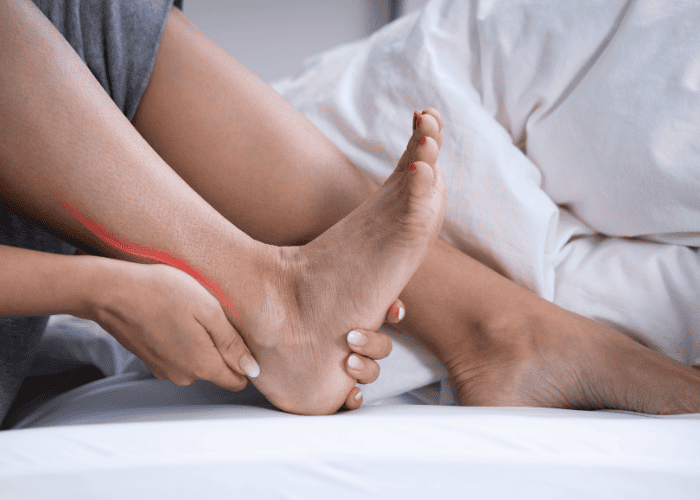
As the largest and most vulnerable tendon in the body, the Achilles tendon joins the gastrocnemius and soleus muscles of the lower leg to the calcaneus. Accounting for approximately 10–12 percent of all running injuries, inflammation or degeneration of this tendon is appropriately named Achilles tendinitis (also referred to as Achilles tendinopathy). Although the slow healing time for Achilles tendinitis is due to limited localized blood supply, bodyworkers can play a key role in restoring this tendon to its pre-injured state.
Symptoms of Achilles Tendinitis
Providing the power in the push-off phase of the gait cycle, the Achilles tendon can become irritated when the gastrocnemius and soleus muscles are stressed. Although this tendon is strong, its lack of flexibility can easily lead to inflammation, micro-tears, or rupture. Achilles tendinitis can be acute or chronic.
Signs of Acute Achilles Tendinitis
- Tendon pain during exercise. Achilles pain gradually comes on with prolonged activity and typically improves with rest.
- Swelling over the Achilles tendon.
- Redness over the affected area of the tendon.
- A creaking or crackling sensation may be felt when pressing into the tendon while moving the foot.
Signs of Chronic Achilles Tendinitis
Often more difficult to treat, chronic Achilles tendinitis may develop when the tendon is not treated properly or allowed to fully heal. When this problem becomes chronic, the pain may disappear after a warm-up yet return once activity stops. If the Achilles is repeatedly stressed, the injury worsens until running or walking becomes difficult. In addition to the symptoms of acute tendinitis, chronic cases may include:
- Pain and stiffness in the Achilles tendon in the morning. This pain may be described as diffuse along the tendon rather than specific.
- There may be nodules or lumps in the Achilles tendon, particularly 2–6 cm above the heel.
- Pain in the tendon when walking up a hill or up stairs.
Causes of Achilles Tendinitis
An injury typically occurring from overuse, Achilles tendinitis usually comes on gradually. Ignoring the early warning signs of Achilles pain allows symptoms to worsen until activity becomes too painful to continue. In general, the more fatigued the calf muscles are, the more stress is placed on the Achilles tendon.
Common causes include:
- Overuse – Sudden increases in activity or training intensity without adequate recovery
- Running up hills – Hill running increases Achilles stretch and loading with every stride
- Overpronation – Overly pronating the foot increases the strain placed on the Achilles tendon. As the foot rolls in and flattens, the lower leg rotates inwards causing a twisting motion. This twist puts an additional strain on the Achilles
- Tight or weak calf muscles – Fatigued or shortened gastrocnemius and soleus muscles place added strain on the Achilles
10 Solutions for Achilles Tendinitis
For best results, a sore or achy Achilles tendon responds best to early attention and load management. Left untreated, Achilles tendinitis can cause persistent pain or lead to tendon rupture, which may require surgery. Ten commonly advised solutions include:
- Resting the calf muscles and avoiding painful activity
- Applying cold therapy or ice for short-term symptom relief
- Wearing a heel pad to raise the heel, thus taking some of the strain off the Achilles tendon
- Wearing arch support insoles or orthotics to prevent overpronation and improve foot biomechanics
- Taking anti-inflammatory medication as directed by a healthcare provider
- Taping or bracing the lower leg to support the Achilles
- Immobilization (walking boot or cast) for more severe cases
- Therapeutic ultrasound or shockwave therapy when prescribed
- Administering sports massage to the lower extremities
- Strengthening the calf muscles to help reduce stress on the Achilles tendon. Controlled heel-lowering exercises (eccentrics), toe raises, and wall stretching are useful.
Whenever discussing approaches to Achilles tendinitis with clients, always emphasize avoiding excessive stretching in the acute phase. Taking this action has the potential to aggravate an already stressed Achilles.
Sports Massage for Achilles Tendinitis
Sports massage can play a supportive role in managing Achilles tendinitis, particularly when used alongside load‑management strategies and strengthening exercises. While some traditional techniques remain popular in clinical practice, modern tendon research has prompted a more nuanced understanding of what massage can, and cannot, do for an irritated Achilles tendon. Three techniques commonly used by bodyworkers include transverse friction massage, pressure massage, and strain‑counterstrain.
Transverse Friction Massage
Transverse friction massage has long been used for tendinitis, with the intention of reducing pain, improving local circulation, and limiting the formation of adhesions in the connective tissue. The strokes are applied deeply and perpendicular to the tendon fibers.
However, research on its effectiveness for Achilles tendinitis is contradictory. Some practitioners report short‑term symptom relief, while others note that modern tendon science does not support the idea that friction techniques can repair tendon tissue or “break down adhesions” in a meaningful way. Several sports‑medicine sources emphasize that Achilles tendinopathy is primarily a load‑management and strengthening issue, and that friction massage alone does not change the underlying tendon pathology.
Because of these conflicting viewpoints, transverse friction massage is best considered a supportive technique, potentially helpful for reducing discomfort in some clients, but not a primary treatment for tendon healing.
Pressure Massage
Pressure massage is a deep, sustained, gradually increasing compressive technique applied along the calf–Achilles complex. Unlike transverse friction, pressure massage does not rely on cross‑fiber strokes. Instead, it uses slow, tolerable pressure to modulate sensitivity in the tissues surrounding the tendon.
A randomized controlled trial published in the Orthopaedic Journal of Sports Medicine found that pressure massage produced similar improvements in pain and function as the gold‑standard eccentric loading protocol. This makes it one of the few manual therapy approaches with direct evidence supporting its use for Achilles tendinopathy.
Pressure massage may help by:
- Reducing local sensitivity
- Improving tolerance to mechanical load
- Supporting clients who struggle to perform or adhere to strengthening exercises
While it does not repair tendon fibers, it can be a valuable adjunct to a comprehensive treatment plan.
Strain-Counterstrain Techniques
Strain‑counterstrain is a gentle positional release technique used to reduce neuromuscular tension in the calf muscles. By placing the gastrocnemius and soleus in shortened, comfortable positions, the technique aims to quiet protective reflexes that may be contributing to excessive pull on the Achilles tendon.
A study published in the Journal of the American Osteopathic Association found that applying strain‑counterstrain to the calf muscles produced a measurable reduction in localized tendon stress in individuals with Achilles tendinitis. This makes it one of the few manual techniques with research demonstrating a direct effect on the mechanical environment of the tendon.
Strain‑counterstrain is especially useful for clients who present with:
- Protective muscle guarding
- Heightened sensitivity
- Difficulty tolerating deeper manual techniques
Long-Term Recovery and Prevention
While early and persistent attention to this injury often results in a full recovery, making sure the original cause of the tendinitis is addressed is the only way to prevent its recurrence. In addition to tackling the reason for Achilles pain, most practitioners recommend some combination of the above ten solutions to help an inflamed Achilles heal.
A massage therapist using evidence‑supported techniques such as pressure massage and strain‑counterstrain can play a supportive role in helping clients manage symptoms and maintain healthy loading patterns during recovery.
Originally posted March 2008. Updated January 7, 2026.
Earn continuing education credit for this article contained in our Common Sports Injuries series. Click here to enroll.
 Follow Us


I disagree with the comment below – thanks for this useful article.