






Strokes Defined
A stroke, clinically called a cerebrovascular accident, occurs when blood flow to part of the brain is interrupted by a blocked blood vessel or when a blood vessel ruptures and causes bleeding in or around the brain. The resulting hypoxia and loss of nutrients can damage or kill brain cells.
The term ischemic stroke is used if caused by an occluded (blocked) vessel. The term hemorrhagic stroke is used if caused by a blood vessel bursting.
Many patients may experience a transient ischemic attack (TIA), sometimes called a mini-stroke. A TIA causes temporary stroke-like symptoms and is a medical emergency even if those symptoms disappear. It may be a warning of an increased risk of a future stroke, but there is no way to determine initially whether a person is experiencing a TIA or a major stroke. Call 911 immediately for any stroke symptoms.
In a First Aid class, students will learn the mnemonic FAST to help one quickly recognize if someone is having a stroke. FAST stands for:
Face: Stand in front of the patient. Notice any unilateral changes or drooping of the face.
Arm: Ask the patient to lift both arms in front of their body. Notice unilateral weakness of an arm upon this movement.
Speech: Have the patient speak to you. Notice any slurred or impaired speech.
Time: Do not delay in contacting 911 for medical assistance.
Other possible warning signs include sudden numbness or weakness, confusion, difficulty seeing, dizziness, loss of balance, trouble walking or a severe headache with no known cause.
What to Do During a Suspected Stroke
If a client develops signs of a stroke during a massage session:
- Stop the session and call 911 immediately.
- Note when the symptoms began or when the person was last known to be well.
- Help the person rest in a safe, comfortable position.
- If the person is responsive but not fully awake, is drooling or is having difficulty swallowing, place them in the recovery position when it is safe to do so.
- Do not give food, beverages, medications or aspirin unless instructed by emergency personnel.
- Monitor responsiveness and breathing.
- Be prepared to provide appropriate first aid or CPR if needed and if trained to do so.
- Remain with the person until emergency medical services arrive.
Do not elevate the person’s legs as a routine response to a suspected stroke. Follow the instructions provided by the 911 dispatcher.
Common Medical Treatments
Stroke treatment depends heavily on whether the stroke is ischemic (due to a blood clot) or hemorrhagic (due to bleeding). Additionally, when symptoms first arose and the person’s overall condition are factors to consider.
Common Treatments
1. Emergency Treatment
- Ischemic stroke: Clot-resolving medication such as alteplase or tenecteplase may be given to eligible patients, generally within a limited time window. Anticoagulants and antiplatelets may also be prescribed.
- Mechanical thrombectomy: For certain large blood clots, doctors can thread a catheter into the brain artery and physically remove the clot. Some eligible patients can receive this treatment up to 24 hours after symptoms begin, depending on brain imaging.
- Hemorrhagic stroke: Treatment focuses on controlling bleeding and pressure in the brain; some patients require procedures or surgery. Concurrent cerebral edema and seizure activity may need to be managed as well.
- Brain imaging is recommended to determine the cause of the stroke.
2. Hospital Medical Care
Doctors may manage:
- Blood pressure and blood glucose
- Brain swelling and other complications
- Swallowing problems and nutrition
- Heart rhythm problems
- Seizures when they occur
- Prevention of complications such as blood clots, pneumonia and falls
3. Medications to Prevent Another Stroke
Depending on the cause, doctors may prescribe medications such as:
- Antiplatelet drugs (aspirin/Plavix) for certain ischemic strokes
- Anticoagulant drugs (warfarin/heparin) for some patients whose stroke was caused by atrial fibrillation or another cardiac source
- Cholesterol-lowering medications
- Blood-pressure medications
- Treatment for diabetes and other cardiovascular risk factors
These medications are not interchangeable, and aspirin or blood thinners should not be started on your own after a suspected stroke because they can be dangerous in a hemorrhagic stroke.
4. Rehabilitation
Once medically stable, rehabilitation is a major part of recovery. It commonly includes:
- Physical therapy: Walking, balance, strength and coordination
- Occupational therapy: Dressing, bathing, eating and other daily activities
- Speech-language therapy: Speech, language, communication and swallowing
- Cognitive rehabilitation: Memory, attention and problem-solving
- Psychological/emotional support when needed
Rehabilitation can begin in the hospital and continue through inpatient rehabilitation, skilled nursing, outpatient therapy or home-based therapy, depending on the patient’s needs.
Massage Considerations
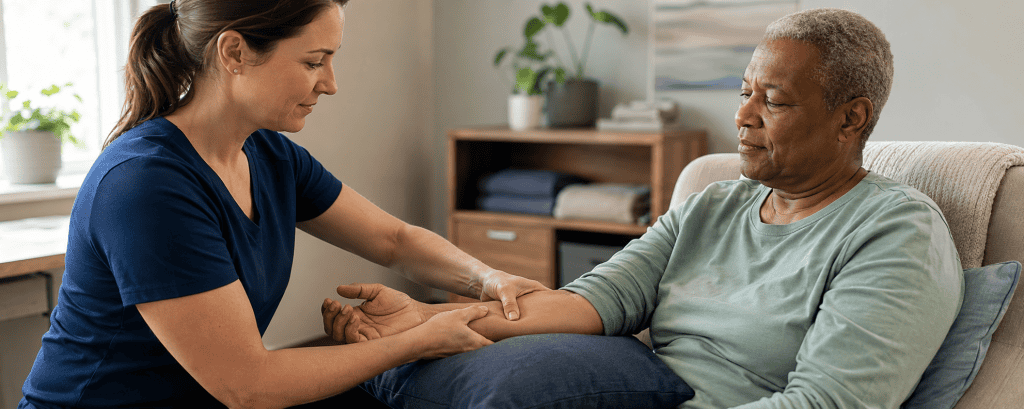
Massage and bodywork can be used as complementary therapy after a stroke. These should complement, not replace, stroke rehabilitation such as physical and occupational therapy. Current stroke guidelines emphasize individualized, coordinated rehabilitation, while treatments for spasticity focus on stretching, range-of-motion work, movement, medications, injections and other targeted therapies.
Research concerning massage for stroke survivors remains limited. A 2021 systematic review found some evidence that massage, when provided in addition to conventional treatment, may help improve motor function and reduce spasticity. However, the included studies varied in quality and treatment methods, so massage should not be presented as a stand-alone treatment or a proven method of restoring neurological function.
Potential Uses of Gentle Massage and Bodywork
- Relaxation and comfort: Gentle massage may help with general muscle tension and promote relaxation.
- Muscle stiffness: Light hands-on work may temporarily make tight muscles feel more comfortable, particularly when combined with stretching and movement.
- Pain management: It may be useful as an adjunct for some types of musculoskeletal discomfort.
- Body awareness: Gentle sensory stimulation can sometimes help a person become more aware of an affected limb, although it shouldn’t be presented as a proven way to restore neurological function.
- Preparing for therapy: Gentle work followed by prescribed range-of-motion or functional exercises may be useful as part of a rehabilitation session.
Be Particularly Careful With Spasticity
Spasticity is common after stroke and can cause stiff, painful muscles and abnormal positioning. The American Stroke Association recommends assessment by a healthcare professional. Treatment may include combinations of stretching, exercise, medications, botulinum toxin, electrical stimulation, braces and other interventions, depending on severity.
Massage should generally be gentle rather than aggressive. Deep tissue work, forceful stretching, rapid joint manipulation or trying to “break up” a contracted muscle can be inappropriate. When medically appropriate, light face and scalp massage may provide comfort, encourage relaxation and help ease muscular tension.
Craniosacral therapy is a gentle, noninvasive form of bodywork that some therapists may incorporate into a massage session. Based on principles originally developed by osteopathic physician William Garner Sutherland, the modality uses gentle contact intended to address restrictions and tension involving the cranial and fascial structures.
Although a six-week waiting period is sometimes taught in massage and craniosacral therapy classes to allow the body time to heal as inflammation eases and tissues restore integrity, there is no universal evidence-based rule requiring every stroke survivor to wait exactly six weeks before receiving massage. Massage should not be provided during an acute stroke or while the patient is medically unstable. The appropriate time to begin depends on the type and severity of the stroke, medical stability, medications, complications and the recommendations of the patient’s physician or rehabilitation team. Medical clearance should be obtained before massage begins.
Important Precautions
Before providing massage, encourage the patient to consult their physician or rehabilitation therapist to clarify any specific needs and goals for their recovery.
Extra caution is warranted if the person has:
- Significant loss of sensation or inability to communicate pain
- Severe spasticity or contractures
- Shoulder subluxation or a painful or unstable shoulder
- Swelling or a suspected blood clot
- Fragile skin or pressure injuries
- Uncontrolled blood pressure or significant cardiovascular problems
- Recent surgery or other medical complications
- Difficulty maintaining balance or safely changing position
- Anticoagulant or antiplatelet use that may increase bruising or bleeding risk
For a person with a weak arm, do not pull on the affected arm or use it to reposition the person. Shoulder injuries can occur after stroke, so positioning and transfers should follow the rehabilitation team’s instructions.
Remember that massage is not a substitute for task-specific rehabilitation. Stroke recovery programs use coordinated physical, occupational and speech therapy tailored to the person’s impairments and goals.
Massage and bodywork can be a wonderful complementary treatment for stroke patients. As my entry-level teacher, Lynette Smith, often stated in class, “A good massage makes a client feel lighter, looser, longer.” This can apply to stroke patients as well, as appropriately provided massage may promote relaxation, comfort and a greater sense of well-being during recovery.
 Follow Us


What I wanted to say before I read the whole article and i see that it was addressed further in your article is that stroke patients don’t usually have a sense of feeling in the limb that needs treatment the most.
A person can gently massage and stretch the flexor muscles of the limb to increase elasticity. The patient won’t have more control of the limb but it does improve the pain from chronically hypertonic muscles temporarily
I’m a massage therapist who had a stroke 8 years ago, and I had another friend who had a more severe stroke 4 months after mine. His wife told me that it was good to deeply massage his affected arm until he painfully felt it. She said his physical therapist did this to reconnect the arm with the brain. I always had a problem with the application of the deep technique, because it caused pain. I think a more meaningful approach would have been more beneficial.
I’m very happy to read your article on this.