






“Carpal Tunnel” and “Thoracic Outlet” are nerve compression syndromes witnessing entrapment of nerve structures creating a myriad of signs and symptoms. There are many similarities reported by patients regarding their patient experience with either condition. There are also key distinctions between these two nerve compression syndromes.
This article will compare and contrast both conditions to help massage therapists better understand these two conditions. It is important to note that information presented is never intended to replace advice from a medical professional. Please honor requests of the physician and complimentary practitioners in the care of one’s health condition.
What does Carpal Tunnel Syndrome entail?
Carpal Tunnel Syndrome (CTS) involves nerve impingement within the carpal tunnel upon the anterior aspects of the wrist. Flexor muscle tendons travel through this space. Swelling within the tunnel or other factors that narrow the space can place pressure on the median nerve.
Causes and Risk Factors for Carpal Tunnel Syndrome
According to Mayo Clinic, there are numerous causes of CTS which include: (1)
- Physical factors such as wrist fracture and bone/joint injuries
- Repetitive forceful wrist movement and vibrating tools may contribute, although workplace activities have not been proved to cause every case
- Neurological disease and damage due to chronic conditions such as Diabetes
- Inflammatory conditions such as Arthritis
- Fluid retention which commonly occurs during menopause and pregnancy
- Sleep positions in which the wrist and forearm are consistently compressed
Signs / Symptoms
Major signs / symptoms include:
- Atrophy of the thenar muscles
- Tingling or numbness primarily in the thumb, index, middle, and ring fingers; the little finger is usually spared.
- Neuropathy within fingers and wrists
- Pain within wrist and hand
- Loss of grip strength
- Loss of wrist and digit joint function
- Interference with sleep
Diagnostic Features
Doctors use several criteria to determine a diagnosis of CTS:
Physical examination:
- Inspection of the hands for muscle atrophy, asymmetry, and signs of osteoarthritis
- Assessment of thumb muscle strength
- Assessment of sensation within the median nerve distribution
- Wrist flexion or extension to reproduce symptoms (Phalen’s and reverse Phalen’s tests)
- Tapping over the median nerve at the wrist to reproduce tingling (Tinel’s test)
- Compression over the median nerve at the wrist to reproduce symptoms (carpal compression test)
- Elevation of the hands above the head to reproduce symptoms (hand elevation test)
Additional diagnostic tests, when indicated:
- X-rays to rule out other causes such as arthritis or fracture
- Electromyography to assess muscle electrical activity and possible nerve or muscle damage
- Nerve conduction studies to assess signal transmission through the median nerve
Prevalence
A study published in 2013 found that 7.8% of participants in six U.S. working populations had CTS at the start of the study, with about 2.3 new cases per 100 workers each year. Women are more likely to develop CTS than men.
Treatments
Non-surgical treatments include:
- Wrist splinting and bracing
- NSAIDs (non-steroidal anti-inflammatory drugs) may relieve pain but do not correct nerve compression; risks vary by medication and person. Common side effects are gastrointestinal challenges, headaches, high BP, tinnitus and stomach ulcers
- Corticosteroid injections may provide temporary relief; the clinician should discuss their benefits and risks. Common side effects include weight gain, headaches, gastrointestinal issues, blurry vision / cataracts, impaired immunity, easy bruising and muscle weakness
- Physical Therapy
- Yoga Therapy
- Image-guided hydrodissection, sometimes using saline, is being studied but is not a standard first-line treatment
- Massage therapy
Surgical treatments include:
- Open release -> Small incision at the base of the palm to divide the transverse carpal ligament (TCL) to reduce pressure on the median nerve.
- Endoscopic release -> Small camera guides surgeon through the palm to divide the TCL. The choice of technique and recovery depend on the individual case.
Ultrasound-guided release may be used in selected cases. Imaging guidance does not eliminate surgical risks or guarantee that pain medicine or rehabilitation will be unnecessary.
What does Thoracic Outlet Syndrome entail?
Thoracic Outlet Syndrome (TOS) features a compression of nerve and vessel structures at the subclavian region (inferior and deep to the clavicle bone). There are three distinctive types:
- Neurogenic—Featuring symptoms mimicking neurological carpal tunnel syndrome. Check mid-clavicle for impingement.
- Arterial—Featuring a lack of radial pulse, pallor, cyanosis and cold sensations of the hand. Check mid-clavicle for impingement.
- Venous—Featuring swelling (edema), bluish discoloration, and a feeling of heaviness in the affected arm. Blood clots are a significant concern with this type. Compression typically involves the subclavian vein near the clavicle and first rib.
An anatomical anomaly leading to TOS in some patients features the presence of a cervical rib, either unilaterally or bilaterally. These will be an extensions of the transverse processes of C6 – C7 bones. About 1 : 200 people are born with cervical ribs. Of these individuals, 1 : 10 will witness this rib measure at least 1″ in length. This length may cause probable restrictions of either brachial plexus and/or subclavian vessels. Keep in mind not everyone with a cervical rib will develop TOS. (5)
Classic Signs and Symptoms of TOS
Many of these signs and symptoms mimic those of Carpal Tunnel Syndrome.
- Pain and paresthesia of affected limb
- Shoulder abduction worsens sensations
- Numbness of affected limb
- Loss of muscular strength / grip
- Blood clots within affected limb
- Edema of affected limb
- Atrophy of hand muscles may occur in advanced neurogenic TOS
- Claudication
Diagnostic Features
Doctors use several criteria to determine a diagnosis of TOS:
- Provocative Tests to elicit a nerve or blood flow response
- Imaging such as X-rays, Ultrasound, MRI or CT Scan
- Nerve conduction tests
- Scalene muscle block
Treatments
- Physical therapy to address posture, shoulder strength, mobility, and symptom-provoking movements in neurogenic TOS.
- NSAIDs such as Motrin, Aleve, Celebrex. Side effects include: headaches, gastrointestinal pain, blurry vision, fatigue and bowel challenges.
- Thrombolytic medications to dissolve clotting potential.
- Anticoagulant medications to proactively decrease chance of clotting.
- Surgical options
- First Rib Resection—Partial removal of the first rib.
- Scalenectomy / Scalenetomy—Removal (-ectomy) or severing (-tomy) of the scalenes
musculature between neck and upper ribs. - Freeing tissue space either Supraclavicular and/or Transaxillary.
- Angioplasty and/or Venoplasty to repair arteries and/or veins.
Prevalence
A study published in 2021 estimated approximately 25 new cases of neurogenic TOS and 8 new cases of venous TOS per million people each year in the metropolitan area studied.
Specific Tests
The following is a list of specific physical therapy related tests that can contribute to the assessment of CTS or TOS. Keep in mind that no one test establishes a diagnosis on its own.
Carpal Tunnel Testing
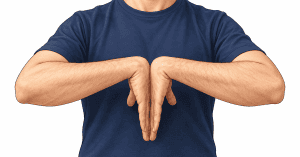

Phalen’s Test
Client presses the dorsal surfaces of the hands together in front of themselves with wrists flexed as much as possible. Hold this position for up to 30 seconds. Reproduction of familiar CTS symptoms can help support a CTS diagnosis.
The test can also be performed in reverse position with client palms touching.
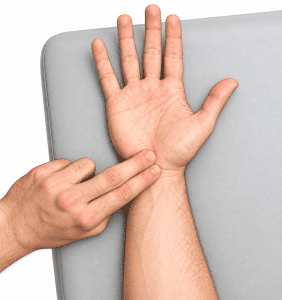 Tinel’s Test
The practitioner lightly taps over the median nerve on the palm side of the client’s wrist. Tingling or an electric shock sensation into the thumb, index, middle, or thumb side of the ring finger is a positive response and can help support a CTS diagnosis.
 Carpal Tunnel Compression
Practitioner firmly compresses upon the carpal tunnel itself (just distal to the wrist crease between thenar and hypothenar muscles). Compression is held firmly for up to 30 seconds. A recurrence of symptoms can help support CTS diagnosis.
Thoracic Outlet Specific Tests
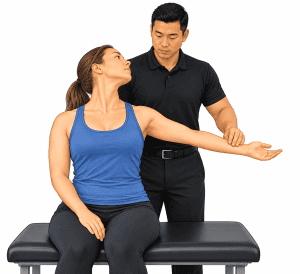
Adson’s Test
Client seated with ideal posture, the therapist locates the radial pulse on the affected side, then extends and externally rotates the client’s arm. The client extends the neck, rotates the head toward the affected side, and takes a deep breath while the therapist monitors the pulse. A decrease or disappearance of the radial pulse, or reproduction of symptoms, may indicate thoracic outlet syndrome (TOS).
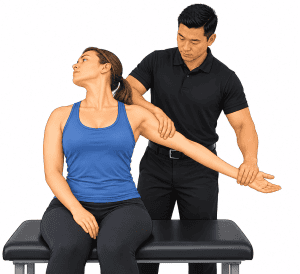 Halstead’s Maneuver (Reverse Adson’s Test)
Client seated with ideal posture, the therapist locates the radial pulse on the affected side. The therapist positions the arm in slight abduction, extension, and external rotation while applying gentle downward traction. The client then extends the neck, rotates the head away from the affected side, and takes a deep breath while the therapist monitors the pulse. A decrease or disappearance of the radial pulse, or reproduction of symptoms, may indicate thoracic outlet syndrome (TOS).
Roos Test
Client seated with ideal posture, both shoulders are abducted and externally rotated to 90 degrees of abduction, with the elbows flexed to 90 degrees and palms facing forward. The client repeatedly opens and closes their hands for up to three minutes. Reproduction or worsening of symptoms such as pain, numbness, tingling, or weakness may indicate thoracic outlet syndrome (TOS).
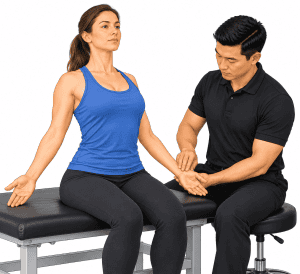
Costoclavicular Test
Client seated with ideal posture, the therapist locates the radial pulses on both sides. The client then draws both shoulders backward and downward, as in a military attention posture, while keeping the head and neck neutral. The client maintains this position for 30–60 seconds while the therapist monitors the radial pulse and asks about symptoms. A decrease or disappearance of the radial pulse, or reproduction of symptoms such as numbness, tingling, or pain, may indicate thoracic outlet syndrome (TOS).
Differential Assessment: Distinguishing CTS From Other Conditions
Several conditions affecting the upper extremities can produce symptoms that overlap with carpal tunnel syndrome. The following assessments may help identify other potential causes of pain, numbness, tingling, or weakness. These tests do not directly assess CTS, and positive findings do not necessarily rule out its presence.
Finkelstein Test
The therapist stabilizes the client’s forearm and gently moves the wrist into ulnar deviation while holding the client’s thumb across the palm. Pain along the thumb side of the wrist may indicate De Quervain’s tenosynovitis, a condition affecting the abductor pollicis longus and extensor pollicis brevis tendons.
Mill’s Test
With the client’s forearm pronated, the therapist passively flexes the wrist while gradually extending the elbow, stretching the wrist extensor muscles and tendons. Reproduction of pain near the lateral epicondyle may indicate lateral epicondylalgia (tennis elbow).
Ulnar Nerve Compression
With the client’s elbow slightly flexed, the therapist applies sustained pressure over the ulnar nerve between the olecranon and medial epicondyle for up to 60 seconds. Reproduction of numbness or tingling extending into the ring and little fingers may indicate cubital tunnel syndrome.
Assessing clients for possible musculoskeletal conditions provides a strong foundation for
understanding their condition and health care needs. A massage therapist can then utilize this information to create an effective treatment plan.
 Follow Us